
Key Words: Silicon Wafer Dicing PCB Depaneling Glass Cutting
Home > News > Industry News
【Description】:
A comprehensive technical guide on borosilicate glass material and Chanxan's UV Picosecond Laser Micro-Machining System.
Article Directory /
Borosilicate glass is a specialised glass composition that has earned its place as a material of choice in applications where ordinary soda‑lime glass would fail. Its unique combination of low thermal expansion, high chemical resistance, and excellent mechanical durability makes it indispensable across medical, laboratory, and industrial sectors.
Originally developed in the late 19th century, borosilicate glass (often known by trade names such as Pyrex®, Duran®, or Schott 8330) has become a standard material for:
Medical glass – syringes, vials, ampoules, and implantable devices.
Laboratory equipment – beakers, test tubes, graduated cylinders, and Petri dishes.
Industrial observation windows – sight glasses for high‑temperature reactors and pressure vessels.
Optical components – lenses, filters, and substrates for demanding optical systems.
High‑performance packaging – glass‑to‑metal seals and hermetic enclosures for sensitive electronics.
Despite its outstanding properties, borosilicate glass presents significant processing challenges. Its hardness and brittleness, combined with its low thermal expansion, make traditional mechanical cutting and conventional laser cutting problematic. Ultrafast laser cutting – specifically using UV picosecond (ps) and femtosecond (fs) lasers – has emerged as the only method that delivers crack‑free, high‑quality edges without compromising the material's integrity.
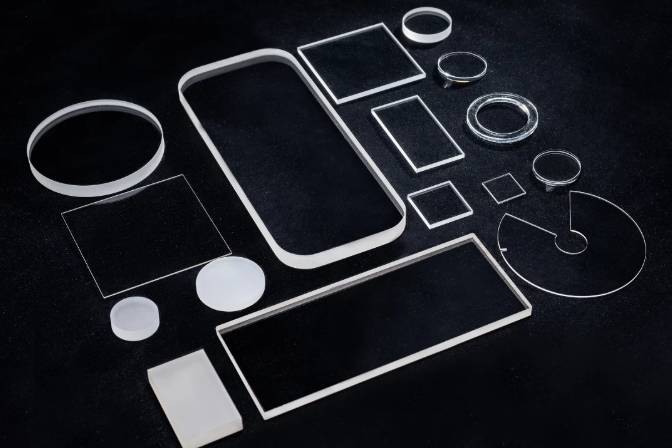
Borosilicate glass is composed primarily of silica (SiO₂) and boron trioxide (B₂O₃), with smaller amounts of alumina and alkali oxides. The key difference from ordinary soda‑lime glass lies in the boron content, which substitutes for sodium and calcium in the glass network.
| Component | Weight % (Typical) | Role |
|---|---|---|
| SiO₂ | 70–80% | Glass former – provides structural network. |
| B₂O₃ | 10–20% | Network modifier – improves thermal and chemical properties. |
| Al₂O₃ | 2–5% | Improves chemical durability and mechanical strength. |
| Na₂O / K₂O | 4–6% | Flux – lowers melting temperature. |
| Property | Borosilicate Glass | Soda‑Lime Glass (Comparison) | Implication for Processing |
|---|---|---|---|
| Coefficient of Thermal Expansion (CTE) | 3.3 × 10⁻⁶ / K | 9.0 × 10⁻⁶ / K | Borosilicate expands much less with heat – thermal shock resistance is far superior. |
| Thermal shock resistance | Excellent (Δt > 150°C) | Moderate (Δt ~ 30–50°C) | Can withstand sudden temperature changes without cracking. |
| Chemical resistance | Excellent (hydrolytic class 1) | Moderate | Resists water, acids, bases, and solvents – ideal for medical and lab use. |
| Softening point | 820–880°C | 700–730°C | Higher operating temperature range. |
| Hardness (Vickers) | 480–520 HV | 450–500 HV | Similar to soda‑lime, but processed differently. |
| Young's modulus | 62–65 GPa | 70–72 GPa | Slightly lower stiffness; easier to bend but still brittle. |
| Transparency (visible) | 90–92% | 90–92% | Optically clear – comparable. |
| UV transparency | Good (down to 320 nm) | Limited | Better transmission in UV spectrum. |
The low CTE of borosilicate glass is its most celebrated property. It allows glass components to be heated, cooled, and exposed to temperature gradients without cracking – a critical feature in laboratory processes and medical device manufacturing.
However, for cutting and machining, this same property presents a challenge:
Thermal cutting methods (CO₂, nanosecond IR) rely on creating a thermal gradient to induce cracking along a path. With borosilicate, the gradient is harder to establish and maintain – the glass simply does not expand enough to create clean separation.
Mechanical cutting – like diamond sawing or scribing – encounters borosilicate's high hardness and brittleness, leading to rapid tool wear and significant edge chipping.
The result: Both thermal and mechanical methods produce edges with micro‑cracks, chipping, and reduced strength – outcomes that are unacceptable for medical and precision applications.
Borosilicate glass is the preferred material for many medical and healthcare applications due to its chemical inertness, thermal stability, and biocompatibility.
| Application | Typical Product | Why Borosilicate Is Chosen |
|---|---|---|
| Syringes and cartridges | Prefilled glass syringes for vaccines and biologics | Chemically inert – no interaction with drugs; low CTE – withstands sterilisation cycles. |
| Vials and ampoules | Injection vials for pharmaceuticals | Glass strength – resists cracking during handling; high hydrolytic resistance – preserves drug integrity. |
| Implantable devices | Optical windows for pacemakers or neurostimulators | Biocompatible; durable; hermetically sealable. |
| Diagnostic slides | Microscope slides for pathology and histology | High optical clarity; stable over time; no autofluorescence. |
Processing requirement: Cut components must have flawless edges – chips and cracks not only compromise integrity but also introduce potential contamination risks. Medical devices are subject to strict regulatory scrutiny; any edge defect can trigger a product recall.
The laboratory environment demands materials that can withstand repeated heating, cooling, chemical exposure, and mechanical handling. Borosilicate glass meets all these requirements.
| Application | Typical Products | Key Requirements |
|---|---|---|
| General glassware | Beakers, flasks, test tubes, graduated cylinders | Thermal shock resistance; chemical resistance; high transparency. |
| High‑temperature apparatus | Distillation equipment, evaporators, drying chambers | Low CTE – withstands rapid heating/cooling; high softening point. |
| Analytical instrumentation | Cuvettes, flow cells, micro‑titer plates | Optical clarity; dimensional stability; low autofluorescence. |
| Custom glassware | Specialised reaction vessels, custom manifolds | Ability to be fabricated to precise dimensions. |
Processing requirement: Laboratory glassware often requires cutting of custom shapes – not all beakers and flasks are standard sizes. OEMs and specialised lab suppliers rely on laser cutting to produce non‑standard geometries with high precision and repeatability.
Observation windows (also called sight glasses or viewports) are used in industrial processing equipment to allow visual inspection of internal processes while maintaining isolation.
| Application | Environment | Why Borosilicate |
|---|---|---|
| Chemical reactors | High‑temperature, corrosive chemicals | Excellent chemical resistance; withstands aggressive media. |
| Pressure vessels | High‑pressure gas/liquid containment | High mechanical strength; low CTE – seals maintain integrity. |
| Furnace viewports | High‑temperature (up to 500°C) | High softening point; thermal shock resistance. |
| Food/pharmaceutical processing | Hygienic equipment requiring visual inspection | Chemically inert; non‑porous; easy to clean. |
Processing requirement: Observation windows are often circular or custom‑shaped – not standard rectangular panels. Laser cutting enables precise, crack‑free creation of these shapes. Additionally, windows often require smooth, polished edges to prevent stress concentration and maintain seal integrity.
Borosilicate glass is also used in optical systems where its low thermal expansion and optical clarity are valued.
| Application | Typical Products | Why Borosilicate |
|---|---|---|
| Lenses and filters | Optical lenses, bandpass filters, beam splitters | Low CTE – maintains optical alignment; good transparency. |
| Fiber optic components | Ferrules, connectors, substrates | Durable; precision‑machinable. |
| Sensor windows | Windows for infrared sensors, UV detectors | High transmission in UV‑Vis‑IR ranges. |
Processing requirement: Optical components demand exceptionally smooth edges and precise dimensional tolerances (±10–20 µm). Any subsurface damage or roughness will scatter light and degrade optical performance.
Borosilicate glass is used in advanced electronic packaging due to its excellent dielectric properties and compatibility with silicon CTE.
| Application | Typical Products | Why Borosilicate |
|---|---|---|
| Glass‑to‑metal seals | Hermetic connectors, feedthroughs | CTE matches to many metals – produces reliable seals. |
| Reed switch encapsulation | Glass capsules for reed relays | Hermetic seal; chemically inert; compact form factor. |
| Optoelectronic packaging | Substrates for LED and laser packaging | Good thermal properties; clean edge quality. |
Processing requirement: These applications often require small‑diameter cutting (e.g., glass tubes) and precise dimensions with no edge defects that could compromise the hermetic seal.
| Method | Mechanism | Edge Quality | Micro‑cracks | Throughput | Suitable for Borosilicate? |
|---|---|---|---|---|---|
| Mechanical diamond saw | Abrasive grinding | Poor – rough; chipping | High – subsurface damage | Moderate | Not suitable – edge quality fails medical and optical standards. |
| Mechanical scribe & break | Scoring + bending fracture | Poor – rough fracture | High – inherent | Fast for straight cuts | Limited – only for straight, non‑critical cuts. |
| CO₂ laser (thermal) | Thermal heating + melting | Poor – molten; recast layer | High – thermal stress | Moderate | Not suitable – thermal damage; micro‑cracks. |
| Waterjet cutting | High‑pressure abrasive | Moderate – can be rough | Moderate | Moderate | Limited – rough edges; requires post‑polishing. |
| Ultrasonic machining | Abrasive slurry + vibration | Moderate – but slow | Moderate | Low | Limited – slow; tool wear; not suitable for high volume. |
| UV picosecond laser | Cold ablation | Excellent – smooth; Ra <0.5 µm | None | High | Ideal – the industry standard. |
UV picosecond laser cutting of borosilicate glass operates on the principle of nonlinear absorption:
The laser beam (355 nm) is focused to a small spot on the glass surface.
The pulse duration (<10 ps) is so short that the peak power density at the focus reaches extremely high levels (GW/cm² to TW/cm²).
At these intensities, the glass absorbs the light through multi‑photon ionisation – an effect that does not occur at lower power densities.
The material is vaporised directly, with no melt phase.
Heat does not have time to diffuse into the surrounding glass – the heat‑affected zone (HAZ) is typically <2 µm.
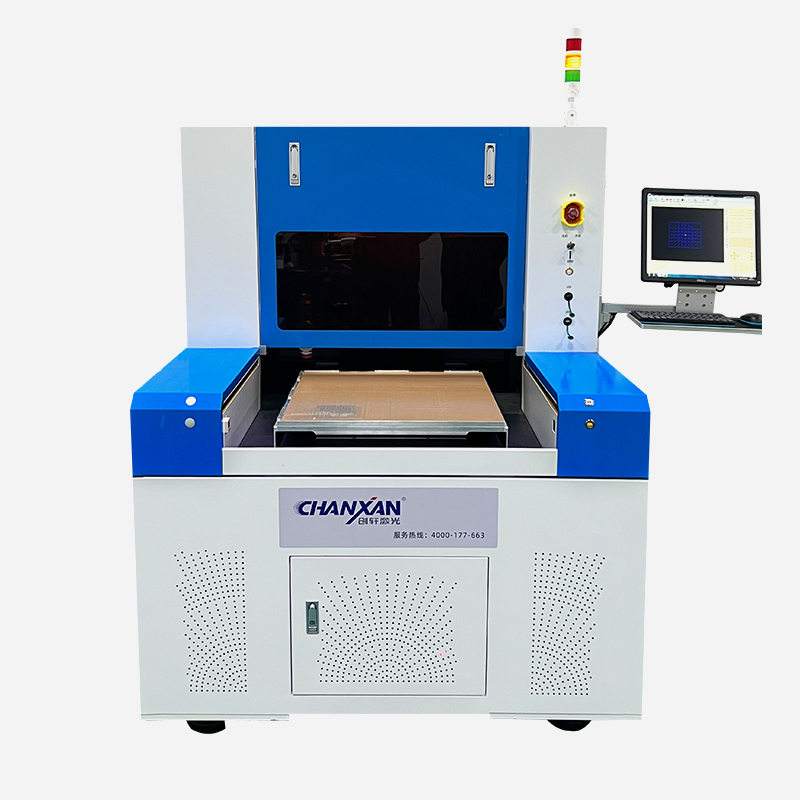
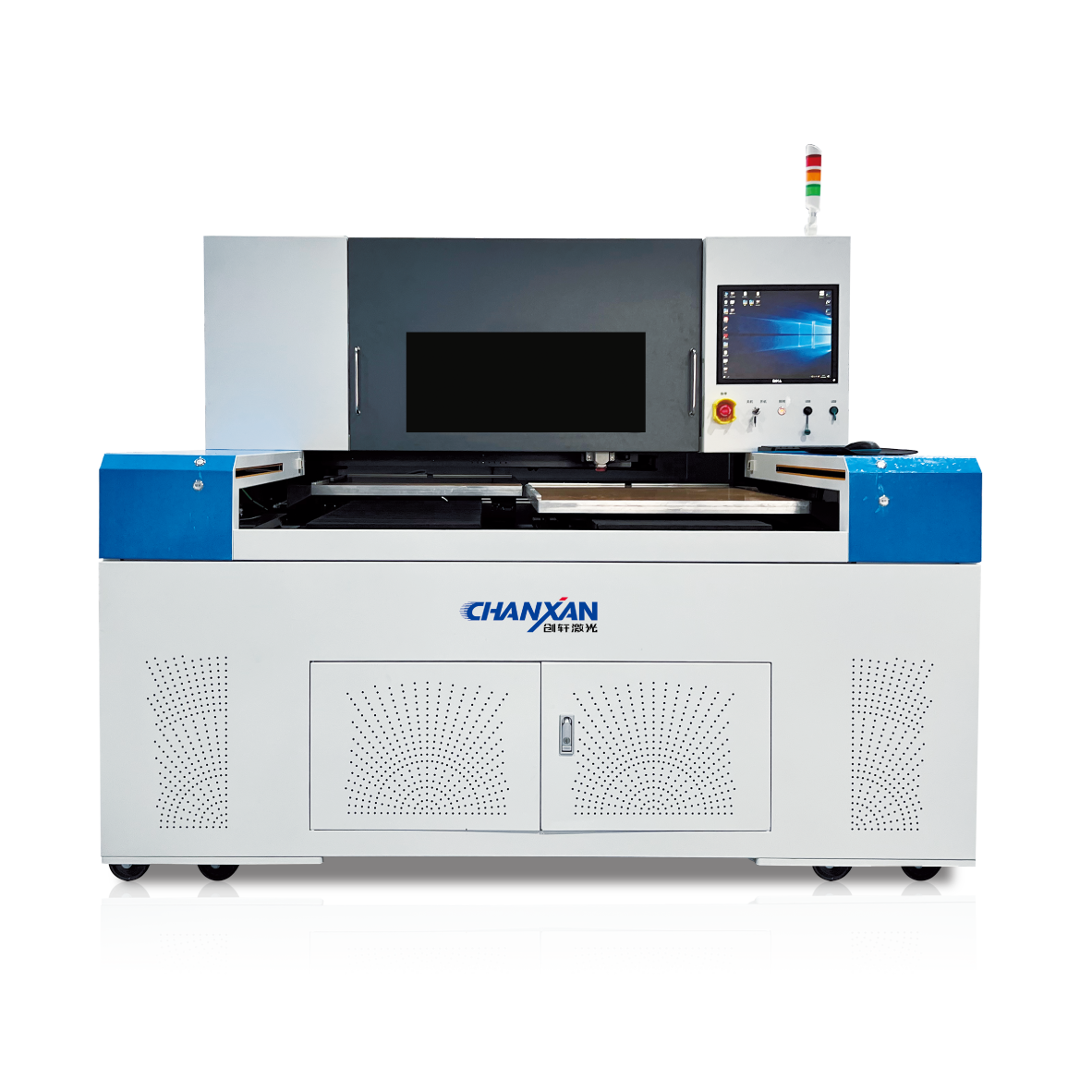
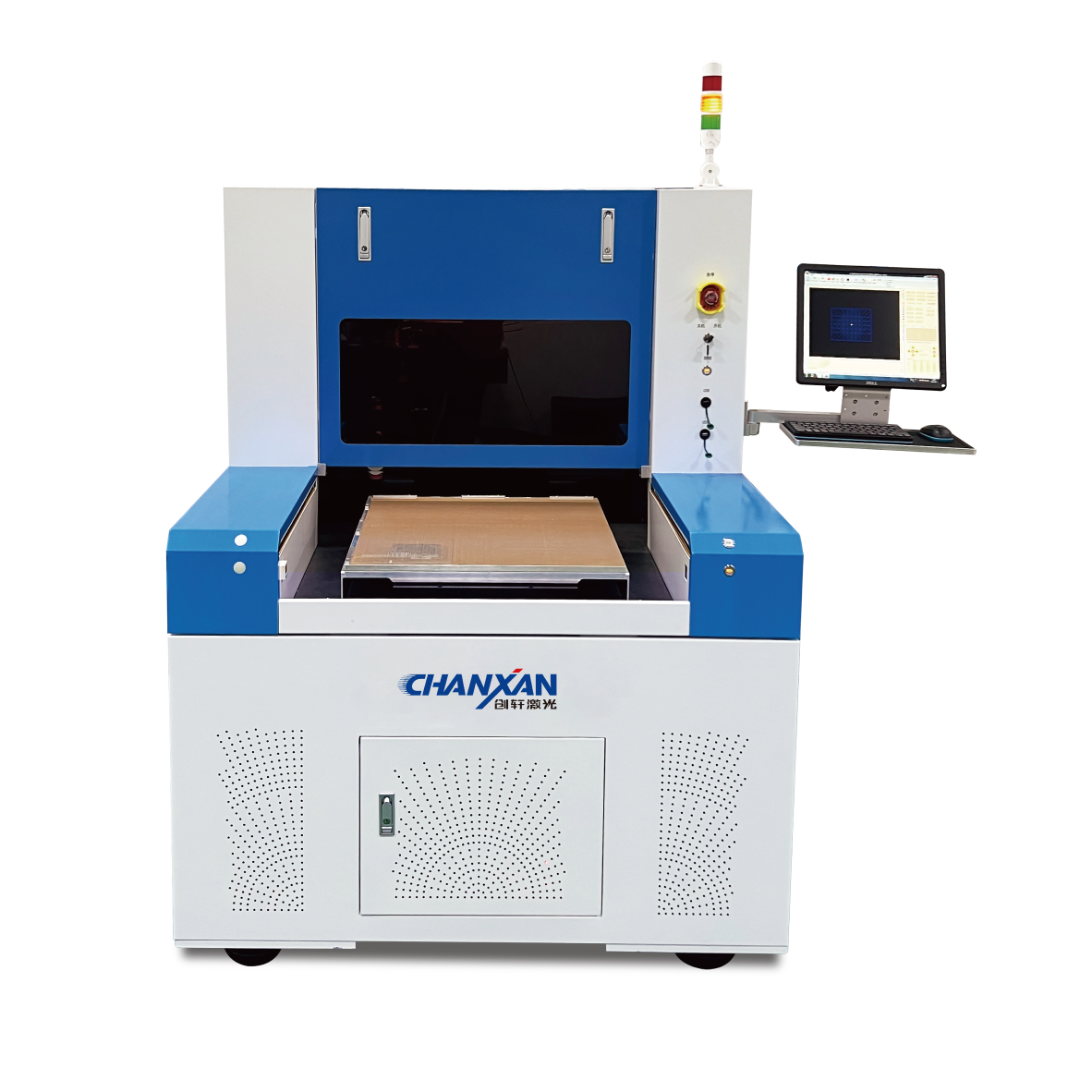
Chanxan Laser provides a dedicated solution for precision cutting of borosilicate glass: the UV Picosecond Laser Micro‑Machining System. This system is engineered to deliver the crack‑free, high‑quality edges that medical, laboratory, and industrial applications demand.
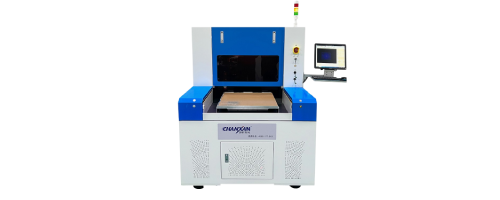
5.1. System Overview
The picosecond laser system is a production‑ready laser micromachining system designed for precision processing of hard, brittle, and transparent materials – with borosilicate glass being a primary application.
| Parameter | Specification | Practical Benefit |
|---|---|---|
| Laser type | UV Picosecond (355 nm) | Strong absorption in borosilicate; enables cold ablation with no thermal damage. |
| Pulse width | <10 ps | Cold ablation – eliminates micro‑cracks; preserves glass strength. |
| Average power | 30W | High throughput – rapid cutting of thick and thin borosilicate. |
| Repetition rate | 400–2000 kHz | Flexible tuning for different thicknesses and cutting geometries. |
| Beam quality | M² <1.2 (TEM00) | Tight focus – precise kerf control; smooth edges. |
| Focus spot size | 20 µm | Enables fine‑detail cutting; tight radii; small holes. |
| Processing accuracy | ≤20 µm | Meets the tight tolerances of medical and optical components. |
| X/Y positioning | ±3 µm accuracy, ±2 µm repeatability | Consistent part‑to‑part quality; high reproducibility. |
| Working area | 600 mm × 500 mm | Large panels – high‑volume production; efficient material utilisation. |
| Motion platform | Granite base + linear motor drives | Vibration‑free; long‑term precision; high uptime. |
| CCD alignment | High‑pixel camera with auto‑recognition | Automatic compensation for panel position; accurate cut placement. |
| Software | Self‑developed with expert process database | Direct DXF/DWG import; parameter‑to‑job binding; rapid job changeover. |
| Debris management | Integrated vacuum chuck + debris extraction | Clean cutting; removes particles; no surface contamination. |
| Focus tracking | Dynamic Z‑axis tracking | Compensates for surface warp; consistent focus across the panel. |
| Certifications | ISO9001, CE, FDA | Proven quality; globally recognised safety. |
| Free solution
Previous: Quartz Glass Laser Cutting – Precision Processing Solution
Next: Ultra-Thin Glass (UTG) Laser Cutting for Foldable Displays – A Complete Guide